Car Wash Wastewater Disposal Dubai:
How to Manage Wash Water Efficiently and Responsibly
Home | Blog
How to Manage Wash Water Efficiently and Responsibly
Home | BlogA busy car wash can process dozens or even hundreds of vehicles in a single day. Every vehicle that enters the washing bay leaves behind more than just a clean exterior. Mud, sand, road dust, oil residues, detergents, tyre particles and other contaminants are transferred into the water used during the cleaning process.
That creates an important operational question:
Where does all that used water go after the vehicle leaves the washing bay?
For businesses operating in Dubai, the answer should involve a planned wastewater management system rather than an improvised drainage arrangement.
Effective Car Wash Wastewater Disposal Dubai is about controlling wastewater from the moment it leaves the vehicle until it reaches an appropriate treatment, discharge or disposal destination.
This is particularly important because Dubai law prohibits discharging vehicle washing water onto pavements or roads. Dubai's sewerage regulations also require car wash stations to have oil-separation traps before wash water is discharged to specified or approved destinations.
There is no single answer that applies to every car wash.
The appropriate route depends on factors such as:
A well-designed facility should know exactly where its wash water is collected and what happens to it afterwards.
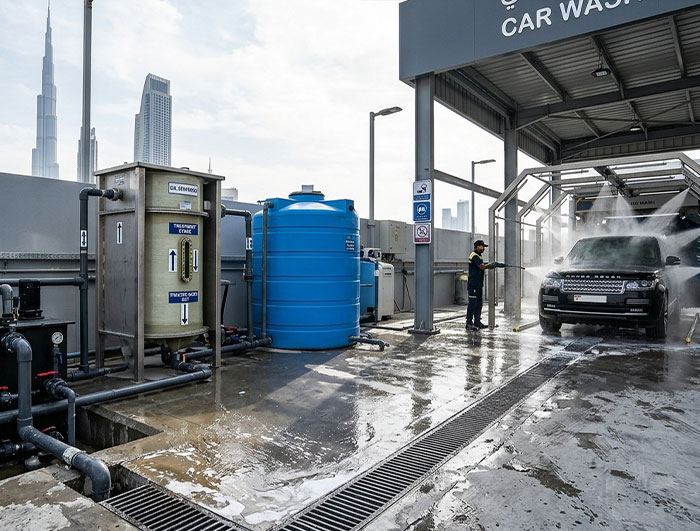
This is the foundation of Car Wash Wastewater Collection Dubai.
Instead of allowing wastewater to travel wherever gravity takes it, the washing area should be designed so that wastewater flows toward a controlled collection system.
Wastewater problems often begin with the physical design of the washing area.
A poorly designed wash bay can allow water to escape through doorways, accumulate in corners or flow toward public areas.
A properly planned washing area should consider:
The floor should direct wastewater toward designated drainage points rather than allowing water to remain stagnant.
Drainage channels should be appropriate for the volume and type of wastewater generated.
Mud, sand and other heavy materials should be controlled before they enter downstream systems.
Oil separation is particularly important because vehicle washing wastewater may contain oil and grease.
Dubai's Local Order No. 8 of 2002 specifically requires car wash stations to have traps that separate oil from wash water before discharge to the public sewerage network, septic tanks, cesspools or another approved location.
The wash area should prevent contaminated water from escaping into public spaces.
These design considerations can make Car Wash Wastewater Management Dubai significantly easier and more reliable.
One of the most common operational mistakes is treating wastewater collection as an emergency service.
A business waits until a tank is almost full and then starts looking for a tanker.
That approach can create unnecessary pressure.
A better strategy is to estimate wastewater generation and establish a planned collection schedule.
For example, a business can monitor:
This information can be used to predict when collection will be required.
Planned Car Wash Wastewater Collection Dubai can reduce the risk of overflow and help the business maintain more consistent operations.
The wastewater generated at a car wash does not remain uniform.
Different materials behave differently.
Sand, mud and heavier particles tend to settle when water slows down.
Over time, this creates sludge.
Oil and grease can behave differently from water and may accumulate in an oil-separation system.
Cleaning chemicals may remain in the water and require consideration during treatment or discharge.
This means simply pumping out visible water does not necessarily mean the entire wastewater system has been properly maintained.
Regular inspection and cleaning of collection tanks, sediment areas and oil-separation equipment are therefore important parts of Car Wash Wastewater Management Dubai.
A car wash may focus heavily on wastewater but overlook the solid material accumulating at the bottom of its collection system.
This sludge can contain:
As sludge builds up, it reduces the effective capacity of the collection system.
That creates a simple chain reaction:
More sludge → less storage capacity → faster filling → higher overflow risk.
Therefore, Car Wash Waste Disposal Dubai should not be limited to removing liquid wastewater. Businesses should also understand how sediment and other accumulated waste are managed.
The correct handling method depends on the material and applicable requirements.
Oil is one of the most important considerations in vehicle washing wastewater.
Small quantities can enter wash water from engine areas, vehicle components, road surfaces and other sources.
This is one reason Dubai requires oil-separation traps for car wash stations before discharge to specified or approved destinations. The relevant regulation also allows intervention where an oil trap is non-functional, inefficient or where testing shows oil content exceeds prescribed limits.
For a car wash operator, this means an oil separator should not simply be installed and forgotten.
It needs appropriate inspection and maintenance.
A neglected separator can become less effective as accumulated oil and solids build up.
Water reuse can be an attractive option for high-volume car wash businesses because reducing freshwater consumption can also reduce operating costs.
However, reuse should not be treated as simply filtering dirty water and immediately sending it back to the washing bay.
Depending on the intended reuse, the treatment system may need to address different contaminants.
A reuse system may involve stages such as:
Collection → sediment separation → oil separation → filtration → additional treatment → storage → controlled reuse
The required treatment depends on the water quality and intended application.
Therefore, businesses considering water recycling as part of Car Wash Wastewater Management Dubai should evaluate the complete system rather than installing equipment based solely on advertised recovery percentages.
There is no universal collection frequency for every car wash.
A facility washing 20 vehicles per day will have very different requirements from one washing 200 vehicles.
Instead of following an arbitrary weekly or monthly schedule, businesses can develop their own collection plan using operational data.
A simple monitoring sheet can record:
| Parameter | Why It Matters |
|---|---|
| Vehicles washed daily | Indicates wastewater generation |
| Water consumption | Helps estimate wastewater volume |
| Tank capacity | Determines storage limitations |
| Tank level | Helps predict collection requirements |
| Sludge level | Indicates loss of effective capacity |
| Oil separator condition | Helps maintain separation performance |
| Collection date | Creates a service history |
This turns Car Wash Wastewater Collection Dubai into a predictable maintenance activity rather than an emergency.
When arranging Car Wash Waste Disposal Dubai, the cheapest quote should not automatically be the deciding factor.
A business should understand the entire disposal chain.
Who is collecting the wastewater?
The company should be appropriately authorised for the relevant waste activity.
What vehicle is being used?
Dubai's 2026 implementing bylaw states that vehicles used for collection and transportation of solid and liquid waste must comply with applicable technical requirements and specifications.
Where is the wastewater going?
A responsible provider should be able to explain the intended treatment or disposal route.
What documentation is available?
Businesses should retain appropriate service records for their operational and compliance needs.
Can the provider handle emergency requirements?
This is particularly important for facilities with high wastewater generation.
The same principles apply to many businesses that generate wastewater through their operations.
For these businesses, Commercial Wastewater Disposal Dubai needs to be integrated into routine facility management.
The objective is to know:
What is generated? → Where is it collected? → How is it managed? → Who transports it? → Where does it go?
Dubai's 2026 implementing bylaw includes requirements concerning waste producers, licensed waste carriers, authorised transportation vehicles and approved disposal sites.
High-volume vehicle washing creates a different operational challenge.
A fleet facility may wash many vehicles at approximately the same time. A dealership may experience peaks during busy periods. A commercial vehicle operator may generate wastewater continuously.
For these businesses, Vehicle Wash Wastewater Disposal Dubai should be planned around peak demand rather than average demand alone.
A useful strategy is to determine:
This information helps businesses create a wastewater system that matches actual operations.
An overflowing collection tank is more than a minor maintenance inconvenience.
It can result in:
Dubai's legislation prohibits discharging vehicle washing water onto pavements and roads.
A useful preventive strategy is to establish an internal warning level before the tank reaches maximum capacity.
Normal level → Warning level → Collection required → Emergency response
This gives the business time to arrange collection before the system becomes critical.
Good wastewater management does not mean simply removing more wastewater.
It also means generating less unnecessary wastewater.
Removing loose dirt before pressure washing can reduce the amount of solids entering the wastewater system.
Using water efficiently can reduce unnecessary consumption.
Leaking hoses, valves and pressure-washing equipment can increase water usage.
Using cleaning chemicals according to product instructions can help avoid unnecessary chemical loading.
Keeping mud and solid waste out of drainage channels can reduce sludge accumulation.
These relatively simple measures can improve the efficiency of Car Wash Wastewater Management Dubai.
Before hiring a company for Car Wash Waste Disposal Dubai, consider more than the service price.
A useful evaluation checklist includes:
Dubai's current implementing framework covers waste-related activities including collection, transportation, storage, treatment and final disposal, and establishes requirements for waste-collection and transportation vehicles.
Businesses requiring broader wastewater support can use Waste Water Removal Services in Dubai for the controlled removal of wastewater from suitable tanks, pits and collection systems before appropriate transportation, treatment or disposal.
The exact service should be selected according to the wastewater characteristics, volume and applicable requirements.
The most effective wastewater strategy is not:
"The tank is full. Find someone to empty it."
Instead, think of the process as a complete operating cycle:
Wash → Collect → Separate → Inspect → Store → Schedule Removal → Treat/Dispose → Record → Maintain
This approach allows businesses to identify problems before they become emergencies.
It can also make Car Wash Wastewater Collection Dubai easier to schedule, improve Car Wash Wastewater Management Dubai, and create a more organised approach to Commercial Wastewater Disposal Dubai.
A successful car wash is not only measured by how clean the vehicle looks when it leaves the facility. The business also needs a reliable system for managing everything removed from that vehicle during the washing process.
That is why Car Wash Wastewater Collection Dubai, Car Wash Waste Disposal Dubai, Car Wash Wastewater Management Dubai, Vehicle Wash Wastewater Disposal Dubai and Commercial Wastewater Disposal Dubai should be considered part of normal business planning.
The most effective approach is proactive: understand wastewater generation, design the washing area correctly, control solids and oil, monitor storage levels, schedule collection before capacity becomes critical and ensure wastewater follows an appropriate treatment or disposal route.
For Dubai businesses, responsible wastewater handling is not simply an environmental consideration. It is also part of maintaining a cleaner, safer and more predictable car wash operation.
Car Wash Wastewater Disposal Dubai refers to the controlled handling, collection, transportation and appropriate treatment or disposal of wastewater generated by vehicle-washing activities in Dubai.
Car Wash Wastewater Collection Dubai prevents used wash water from spreading into unsuitable areas and provides a controlled point from which wastewater can be managed, treated or removed.
No. Dubai Law No. 18 of 2024 prohibits discharging vehicle washing water onto pavements or roads.
Dubai's Local Order No. 8 of 2002 requires car wash stations to have traps that separate oil from wash water before discharge to the public sewerage network, septic tanks, cesspools or another approved destination.
Car Wash Wastewater Management Dubai can include wastewater collection, sediment control, oil separation, storage, treatment where required, scheduled removal and appropriate final disposal.
Car Wash Waste Disposal Dubai involves managing wastewater and associated waste generated from vehicle washing and ensuring it follows an appropriate collection, transportation, treatment or disposal route.
There is no single frequency suitable for every car wash. Collection should be based on vehicle volume, wastewater generation, storage capacity and the facility's operating conditions.
Potentially, yes. However, the wastewater needs suitable treatment for its intended reuse, and the applicable requirements should be confirmed before implementing a reuse system.
Vehicle Wash Wastewater Disposal Dubai refers to the responsible handling and disposal of wastewater produced while washing cars, vans, buses, commercial vehicles and other vehicles.
Commercial Wastewater Disposal Dubai refers broadly to the controlled management and disposal of wastewater generated through commercial activities. The appropriate method depends on the type, quantity and characteristics of the wastewater.

Committed to delivering efficient wastewater collection and treatment, we ensure clean and sustainable solutions for a healthier future.