Automotive Oily Wastewater Disposal Dubai:
Complete Guide for Garages and Vehicle Workshops
Home | Blog
Complete Guide for Garages and Vehicle Workshops
Home | BlogAutomotive businesses deal with oil, lubricants, grease, fuel residues, cleaning chemicals and contaminated water every day. From vehicle servicing and engine cleaning to workshop-floor washing and car detailing, these activities can generate wastewater that requires more careful management than ordinary domestic wastewater.
For garages and vehicle service centres, the challenge is not simply removing dirty water from the premises. The real challenge is identifying contaminated wastewater, preventing uncontrolled discharge, separating oil and solids where appropriate, arranging safe collection and ensuring that the waste reaches an appropriate treatment or disposal facility.
This is why Automotive Oily Waste Water Disposal Dubai is an important part of responsible environmental management for vehicle workshops, garages, car service centres and related businesses.
Dubai Municipality currently lists Law No. 18 of 2024 on Regulation of Waste Management in Dubai, Local Order No. 8 of 2002 concerning sewage, irrigation and water drainage, and Administrative Resolution No. 34 of 2026 concerning the executive regulations of the waste-management law among its waste and sewerage legislation.
Automotive oily wastewater is water contaminated during activities associated with vehicle maintenance, washing, repair and cleaning.
It may contain:
The composition is not necessarily the same at every facility. A car wash can produce large quantities of wash water containing dirt, detergents and oil washed from vehicles, while a mechanical garage may generate wastewater with greater amounts of grease, lubricants and workshop residues.
This difference matters when planning Oil contaminated water disposal Dubai because the correct management process depends on the characteristics and classification of the waste.
Many automotive businesses generate contaminated water without realising how many separate sources contribute to the overall waste stream.
Water used to clean cars, vans, trucks and other vehicles can carry oil, grease, road dirt and other residues from vehicle surfaces.
Cleaning engines and mechanical components can introduce lubricants, grease and other automotive contaminants into wastewater.
Oil leaks and spills can accumulate on workshop floors. When these areas are washed, contaminants can enter the wastewater stream.
Mechanical components may contain oil and grease even after being removed from a vehicle. Washing these components can produce contaminated water.
Detailing operations may generate wastewater containing detergents, dirt, polishing residues and contaminants removed from vehicles.
Understanding these sources is the starting point for effective Vehicle workshop wastewater management Dubai.
Oil and water do not simply become harmless because they are mixed together.
Automotive wastewater can contain free oil, emulsified oil, grease and suspended particles. Depending on the operation, it may also contain cleaning chemicals and other substances.
Uncontrolled disposal can create problems for drainage infrastructure and wastewater-management systems.
Dubai Municipality's technical guidance defines trade wastewater as non-domestic wastewater generated from industrial or commercial operations. It also provides guidance relating to waste that may not be suitable for direct disposal because of hazardous chemical or physical components.
Consequently, Oil contaminated water disposal Dubai should be approached as a managed waste process rather than simply a drainage issue.
A garage does not need to wait until a wastewater problem develops before creating a disposal plan.
A practical system can begin with mapping every area where wastewater is generated.
For example:
Service area → Contaminated water generation → Collection/containment → Separation or appropriate treatment → Authorised transportation → Approved treatment/disposal
This approach makes Garage oily wastewater disposal Dubai more predictable and easier to manage.
A workshop can also determine how frequently wastewater needs to be removed by tracking:
Instead of treating wastewater disposal as an emergency service, a planned collection programme can become part of normal workshop operations.
Effective Vehicle workshop wastewater management Dubai starts before the wastewater reaches a collection tank.
The best approach is to control contamination at the source.
Oil containers, lubricants, fuels and chemicals should be stored carefully. Spill prevention can significantly reduce the amount of contamination entering wastewater.
Sand, dirt, metal pieces and other solid material should be removed before washing whenever practical.
Excessive water use increases wastewater volume. Controlled washing practices can reduce the quantity requiring collection.
Blocked or poorly maintained drains can cause wastewater to accumulate in work areas.
Where an oil-water separator or similar system is installed, regular inspection and maintenance are important.
A predictable collection schedule can prevent tanks or containment systems from becoming overloaded.
These measures turn Vehicle workshop wastewater management Dubai from a reactive activity into an organised environmental-management process.
Not all automotive waste is liquid.
During oil-water separation, wastewater treatment or cleaning activities, a thicker residue can accumulate. This material may contain concentrated oil, grease, dirt and suspended solids.
This is commonly referred to as oily sludge.
It should not automatically be treated in the same way as ordinary wastewater.
Therefore, Oily sludge and wastewater disposal Dubai needs to consider both components separately where required.
Dubai Municipality's published information on waste-oil collection includes categories such as oily sludge, oily wastewater and oily waste from auto workshops. The Municipality also advises users to request a valid oily-waste collection permit before engaging relevant services.
A vehicle workshop can potentially generate both liquid wastewater and semi-solid oily residues.
For example, an oil-water separation system may remove free oil and suspended material from wastewater. The collected residue may then require separate handling.
This is why Oily sludge and wastewater disposal Dubai should be planned as part of an integrated waste-management strategy.
The process may involve:
The exact process depends on the characteristics and classification of the waste.
A responsible Oil contaminated water disposal Dubai programme has several components.
First, the source of contamination is identified.
Second, contaminated water is prevented from mixing unnecessarily with clean water.
Third, suitable containment and collection systems are used.
Fourth, the collected waste is transported through an appropriate waste-management route.
Finally, treatment or disposal is carried out at a suitable facility.
This approach is more effective than attempting to solve the problem only after wastewater has accumulated.
One of the most important decisions for a garage is selecting the right service provider.
Businesses should not choose a provider based solely on the lowest collection price.
A company experienced with automotive waste will understand that oily wastewater, oily sludge and ordinary sewage can require different handling approaches.
Dubai Municipality maintains information about waste-management companies and permitted waste-oil collection activities. Its RASID system is used to monitor waste-management activities, including collection and transportation.
Collection and disposal records can help businesses maintain an organised waste-management history.
Regular collection can be more practical than arranging emergency removal every time storage capacity is reached.
The provider should understand whether the material is oily wastewater, oily sludge, trade wastewater or another waste stream.
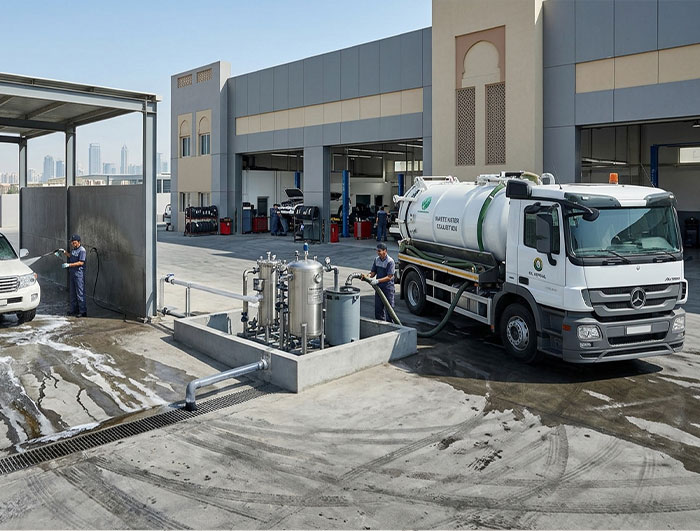
For businesses looking to organise wastewater movement from commercial and automotive facilities, Trade Water Collection Dubai can form part of a broader waste-management plan.
However, collection should not be considered the final stage. Businesses should also consider appropriate transportation, treatment and disposal routes for the specific waste stream.
The easiest wastewater to manage is often the wastewater that does not need to be generated.
Automotive workshops can reduce contaminated water volumes through simple operational changes.
Where appropriate, remove loose oil, grease and dirt using absorbent materials or other dry methods before washing.
Keep suitable spill-control materials available near areas where oil and lubricants are handled.
Oil spills should be contained and cleaned rather than intentionally flushed away.
Leaks from vehicles and machinery can increase contamination levels.
Employees should know which materials can enter a drainage system and which require separate collection.
These practices support better Garage oily wastewater disposal Dubai and can also reduce operational waste-management costs.
Emergency wastewater removal is sometimes unavoidable, but relying on it as the normal operating model can make waste management unpredictable.
A scheduled approach allows workshops to estimate:
For a busy workshop, regular Automotive Oily Waste Water Disposal Dubai services can therefore become part of the facility's routine environmental-management programme.
The appropriate frequency will depend on the business's actual wastewater generation and storage arrangements.
Waste management in Dubai operates within a formal regulatory framework.
Dubai Municipality currently publishes legislation and technical guidance covering waste management, wastewater and related activities. Its Waste Department also provides information on approved hazardous-waste transporters, permitted waste-oil collection companies and waste-processing/recycling premises.
For businesses arranging Oily sludge and wastewater disposal Dubai, keeping relevant service and collection records can make internal monitoring easier.
Depending on the waste stream and service arrangement, documentation may include:
Businesses should verify current requirements for their particular waste stream rather than relying on outdated procedures.
Automotive wastewater management is becoming an increasingly important operational consideration for garages, car service centres, vehicle maintenance facilities and other automotive businesses in Dubai.
The objective should not simply be to remove dirty water from the workshop. A complete strategy considers contamination prevention, wastewater collection, oil separation where appropriate, sludge management, transportation, treatment, disposal and documentation.
A well-planned Automotive Oily Waste Water Disposal Dubai system can help businesses manage their wastewater more systematically while reducing the risk of uncontrolled discharge.
Similarly, Oil contaminated water disposal Dubai, Garage oily wastewater disposal Dubai, Vehicle workshop wastewater management Dubai and Oily sludge and wastewater disposal Dubai should be treated as connected parts of an overall environmental-management strategy rather than isolated services.
For businesses generating automotive wastewater, the most practical approach is to first understand exactly what waste is being produced, then establish a suitable collection and disposal process around that waste.
Dubai Municipality provides current legislation, technical guidelines and information relating to waste-management activities, including waste-oil collection and transportation. Businesses should check the latest applicable requirements and verify the credentials and permissions of their chosen service provider before arranging disposal.
Ultimately, responsible Automotive Oily Waste Water Disposal Dubai is about controlling contamination at its source, managing wastewater systematically and ensuring that oily wastewater and sludge are directed through an appropriate waste-management route.
Automotive oily wastewater is contaminated water generated by activities such as vehicle washing, engine cleaning, parts cleaning, workshop-floor washing and automotive maintenance. It can contain oil, grease, fuel residues, detergents, dirt and suspended solids.
Oil contaminated water disposal Dubai refers to the controlled collection, transportation, treatment and appropriate disposal of water containing oil or petroleum-related contaminants.
Garages can generate wastewater containing oil, grease, lubricants and cleaning chemicals. Garage oily wastewater disposal Dubai helps ensure that contaminated wastewater is managed through an appropriate collection and disposal process rather than being handled like ordinary domestic wastewater.
Vehicle workshop wastewater management Dubai is the overall process of controlling, collecting, storing, treating and disposing of wastewater generated during automotive repair, maintenance, washing and cleaning activities.
Oily sludge is a thicker waste residue that can contain concentrated oil, grease, dirt and suspended solids. It can be generated during oil-water separation, wastewater treatment and cleaning operations.
No. Oily wastewater is primarily a liquid waste stream, while oily sludge is generally a thicker residue containing concentrated contaminants. They may therefore require different handling and disposal arrangements.
Oily sludge and wastewater disposal Dubai normally starts with identifying and separating the relevant waste streams, followed by suitable containment, collection, transportation and treatment or disposal according to the waste characteristics and applicable requirements.
Garages can reduce wastewater generation through spill prevention, dry cleaning before wet washing, efficient water use, proper storage of lubricants and regular maintenance of vehicles and workshop equipment.
Businesses should not automatically assume that automotive wastewater can be treated in the same way as domestic sewage. The wastewater's source, contaminants and classification should be considered before deciding on the appropriate disposal route.
There is no single frequency suitable for every workshop. Collection should be based on wastewater generation, storage capacity, workshop activity and the requirements applicable to the specific waste stream. High-volume facilities may require more frequent collection than smaller garages.

Committed to delivering efficient wastewater collection and treatment, we ensure clean and sustainable solutions for a healthier future.