Sewage Tanker Service for Construction Sites Dubai:
A Complete Guide for Contractors and Project Managers
Home | Blog
A Complete Guide for Contractors and Project Managers
Home | BlogConstruction projects in Dubai involve much more than concrete, steel, machinery and workers. Every active construction site also needs a practical system for managing wastewater and sewage generated by workers, temporary welfare facilities, site offices, portable toilets and other facilities.
Unlike a completed building connected to a permanent sewer network, a construction site may operate with temporary sanitation infrastructure. This creates a need for dependable collection, transportation and disposal arrangements throughout the project lifecycle.
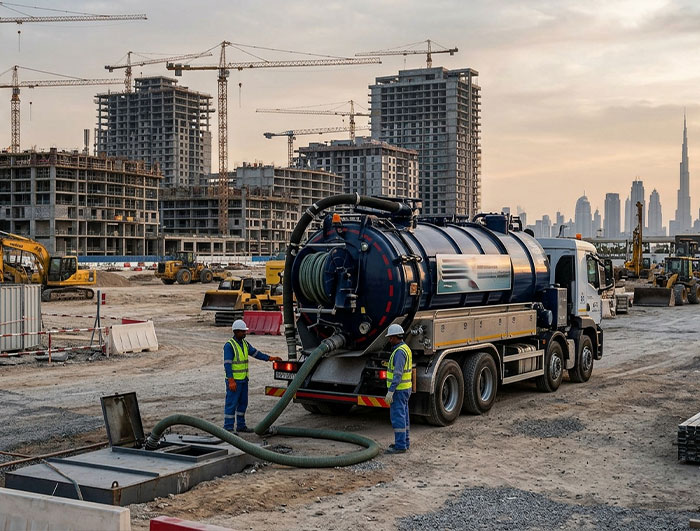
A professional Sewage Tanker Service for Construction Sites Dubai can help contractors manage accumulated sewage without disrupting daily construction activities.
The service is particularly relevant for large building projects, infrastructure works, labour facilities, temporary site offices and developments where permanent sewer connections are unavailable or not yet operational.
Dubai's regulatory framework specifically recognises the transport of sewage water using pumping tankers as a regulated commercial transport activity. The Roads and Transport Authority (RTA) describes the activity as the removal of sewage and sanitation water and suction/removal of stagnant, polluted and surplus water for reuse, treatment or disposal at locations permitted by the competent authorities.
A construction site can have hundreds of workers depending on the size and stage of a project.
Workers need access to toilets, washing facilities, welfare areas and temporary sanitation systems. As these facilities are used throughout the day, sewage accumulates continuously.
If the wastewater storage system is not emptied at the appropriate time, several operational problems can occur.
These may include:
A planned Sewage Tanker Service Dubai arrangement allows project managers to schedule wastewater removal according to the site's actual requirements.
Instead of waiting for a tank to reach capacity, contractors can establish a collection programme based on worker numbers, tank size and daily wastewater generation.
A sewage tanker service uses vacuum or pumping equipment to remove accumulated sewage and wastewater from tanks, holding systems or suitable collection points.
The collected wastewater is transported by tanker to an appropriate treatment or disposal destination.
The exact process can vary depending on the site setup, wastewater type, storage arrangements and applicable requirements.
Dubai Municipality provides a service for registering sewage tankers for unloading at its treatment plants, while RTA separately regulates the commercial transport activity involving sewage water pumping tankers.
This regulatory structure makes it important for contractors to work with service providers that understand the applicable requirements.
Kitchen wastewater is not simply dirty water.
When fats, oils and grease enter drainage systems, they can cool and accumulate on internal pipe surfaces. Food particles can add to the buildup, while detergents and other cleaning products may change the characteristics of the wastewater.
A restaurant that serves hundreds of customers each day can therefore produce a very different wastewater stream from a small café.
This is why Commercial Kitchen Wastewater Disposal Dubai should be considered as part of an integrated kitchen-waste management system.
The objective is to control wastewater from its source until it reaches the appropriate collection, treatment or disposal route.
Grease traps are an important part of wastewater management in many food-service operations.
Dubai Municipality has published a specific guideline covering the maintenance and cleaning of grease traps and the transportation of grease-trap waste to a grease-trap waste recycling plant. The guideline explains that food and grease waste from establishments such as hotels, restaurants, malls and public cafés can be collected and recycled.
This makes grease-trap maintenance more than a routine cleaning task.
For restaurants, proper grease-trap management can support:
A well-managed grease trap can also complement Restaurant Wastewater Collection Dubai by reducing the amount of grease entering downstream wastewater systems.
Catering companies have a unique wastewater challenge.
A conventional restaurant generally operates from a fixed kitchen. Catering businesses, however, may prepare food at central kitchens and then serve meals at hotels, event venues, offices, outdoor locations or temporary facilities.
Wastewater generation can therefore vary dramatically depending on the event.
A small private function may generate limited wastewater, while a large event serving hundreds or thousands of meals can create a much greater waste stream.
For this reason, Catering Wastewater Disposal Dubai should consider:
Planning ahead is particularly important when catering operations take place at temporary or high-volume venues.
A common mistake is treating the kitchen drain as a disposal point for everything that needs to be removed.
Food businesses should minimise the amount of solid food waste, cooking oil and grease entering drainage systems.
Examples of materials that should be controlled include:
Source control can make Commercial Kitchen Wastewater Disposal Dubai more efficient because it reduces the contaminant load entering the wastewater system.
Used cooking oil should also be managed through an appropriate waste-oil collection or recycling route rather than intentionally discharged into drains.
A professional wastewater-management process generally begins by identifying the source of the wastewater.
These may include:
Food particles, excess grease and cooking oil should be prevented from entering drainage systems wherever practical.
Grease traps should be inspected, cleaned and serviced according to operational requirements.
Where a dedicated collection service is required, wastewater can be removed using appropriate equipment.
The provider should have the appropriate registration, permissions or approvals applicable to the waste being transported.
The collected material should reach the appropriate treatment, recycling or disposal destination.
This structured approach makes Restaurant Wastewater Collection Dubai easier to manage and monitor.
Dubai Municipality's technical guidance defines trade wastewater as non-domestic wastewater generated and discharged from industrial or commercial operations.
Restaurant and catering operations can therefore require a different management approach from ordinary household wastewater.
Trade Wastewater Disposal Dubai should be based on the source and characteristics of the wastewater and the applicable requirements for the establishment.
Restaurants should avoid assuming that every wastewater stream can be managed through the same route.
For example, wastewater from a kitchen may contain high concentrations of fats, oils and grease, while wastewater from another commercial operation may contain completely different contaminants.
Understanding the source is therefore the first step in selecting an appropriate disposal method.
Wastewater problems can quickly become operational problems for a restaurant.
A blocked drain can affect food preparation areas. An overflowing grease trap can create unpleasant odours. An overloaded wastewater system can interfere with normal cleaning and sanitation activities.
This is why Trade Wastewater Collection Dubai can be incorporated into a planned maintenance programme.
Instead of waiting until wastewater storage or collection systems become overloaded, businesses can establish a regular schedule based on:
A planned approach can help restaurants identify problems before they become disruptive.
Cloud kitchens can have a different operating model from traditional restaurants.
They may operate multiple food brands from a single kitchen, meaning a relatively compact facility can produce wastewater from several menus and cooking operations.
This can increase the importance of effective grease and wastewater management.
A cloud kitchen should consider:
For such businesses, Restaurant Wastewater Collection Dubai should be aligned with actual kitchen activity.
Catering businesses can experience major variations in wastewater generation.
For example, demand may increase during:
A business that normally handles a moderate wastewater volume may suddenly need to manage significantly more waste during peak periods.
Therefore, Catering Wastewater Disposal Dubai should include contingency planning.
Before a large event, businesses can estimate expected wastewater generation and confirm whether existing storage and collection arrangements are sufficient.
This simple step can reduce the risk of last-minute wastewater problems.
Wastewater management is closely connected with kitchen hygiene.
Standing wastewater, blocked drains, grease accumulation and overflowing waste systems can create an unpleasant working environment.
A clean kitchen therefore requires more than wiping preparation surfaces.
It also requires attention to:
Dubai Municipality provides dedicated guidance and requirements for food establishments, including food-safety-related materials and establishment requirements.
Consequently, Commercial Kitchen Wastewater Disposal Dubai should form part of the broader sanitation and facility-maintenance programme.
Price is important, but it should not be the only selection factor.
Before choosing a provider for Trade Wastewater Disposal Dubai, restaurants and catering companies should consider the following.
Dubai Municipality maintains information relating to waste-management companies and waste activities. It also operates systems for monitoring registered waste-management companies.
A provider handling food-service wastewater should understand grease, fats, oils and kitchen wastewater.
The equipment should be appropriate for the type and quantity of waste being collected.
Regular collection can be more practical for high-volume kitchens than relying entirely on emergency services.
Businesses should retain relevant collection and service records.
Restaurants should understand where their collected waste goes and whether the route is appropriate for the waste category.
Businesses searching for broader commercial wastewater solutions can also consider Trade Water Collection Dubai as part of an integrated wastewater-management strategy.
However, collection should be viewed as one stage of the overall process. Source control, grease management, transportation, treatment and appropriate disposal are equally important.
Professional collection is only one part of the solution.
Restaurants can reduce wastewater-related problems through everyday operational practices.
Removing food scraps before washing can reduce solids entering the drainage system.
Cooking oil should be stored for appropriate collection or recycling rather than poured into drains.
A neglected grease trap can quickly become ineffective.
Using water efficiently can reduce overall wastewater volumes.
Where possible, remove grease and food residues using appropriate dry-cleaning methods before using water.
Employees should understand what should and should not enter the drainage system.
These measures can improve the effectiveness of Restaurant & Catering Waste water Collection Dubai services.
Restaurants usually operate on tight schedules. Kitchen equipment, staff and food preparation all need to work continuously.
Wastewater problems can interfere with that workflow.
A preventive approach allows the business to monitor wastewater generation before it reaches a critical level.
The process can include:
Source control → grease management → drainage monitoring → scheduled collection → appropriate treatment/disposal → record keeping
This approach is more sustainable than waiting for a blocked drain, overflowing grease trap or wastewater-storage problem.
Restaurant wastewater management is not simply a matter of keeping kitchen drains flowing.
Food-service businesses generate a complex combination of wastewater, food particles, fats, oils, grease and cleaning residues. If these materials are poorly managed, they can create drainage, hygiene and operational challenges.
A better approach combines source control, grease-trap maintenance, wastewater monitoring, scheduled collection and appropriate treatment or disposal.
For restaurants, Restaurant Wastewater Collection Dubai can become part of a preventive maintenance programme rather than an emergency response.
Similarly, Commercial Kitchen Wastewater Disposal Dubai should be integrated with kitchen hygiene and facility management, while Catering Wastewater Disposal Dubai should account for changing event volumes and temporary operating environments.
Businesses generating commercial wastewater should also understand their responsibilities regarding Trade Wastewater Disposal Dubai and Trade Wastewater Collection Dubai and verify the current requirements applicable to their particular waste stream.
Dubai Municipality currently publishes waste-management legislation, technical guidance and information relating to waste collection, transportation and disposal. Its guidance specifically addresses grease-trap maintenance and the transportation of grease-trap waste from food establishments.
Ultimately, effective Restaurant & Catering Waste water Collection Dubai is about managing wastewater before it becomes a problem: control contaminants at the source, maintain the kitchen's wastewater infrastructure, arrange collection at the right frequency and ensure the waste follows an appropriate management route.
Restaurant Wastewater Collection Dubai refers to the organised collection and removal of wastewater generated by restaurants, cafés, kitchens and food-service establishments, followed by an appropriate treatment or disposal process.
Commercial Kitchen Wastewater Disposal Dubai is important because kitchen wastewater can contain fats, oils, grease, food particles and cleaning substances that require controlled management.
Catering Wastewater Disposal Dubai can involve managing wastewater generated during food preparation, dishwashing, kitchen cleaning and event-based catering activities. The collection approach depends on the location, volume and characteristics of the wastewater.
Trade wastewater is non-domestic wastewater generated by commercial or industrial activities. Dubai Municipality's technical guidance specifically distinguishes trade wastewater from domestic wastewater.
Trade Wastewater Disposal Dubai involves identifying the wastewater stream, determining its characteristics, arranging appropriate collection and transportation, and directing it to a suitable treatment or disposal route.
Trade Wastewater Collection Dubai is the controlled collection of wastewater generated by commercial or industrial activities. For restaurants, the wastewater may contain food residues, fats, oils and grease.
There is no single frequency that applies to every restaurant. Cleaning requirements depend on the size of the trap, wastewater volume, grease generation and operating conditions. Dubai Municipality has published dedicated guidance covering grease-trap maintenance and cleaning.
It should not be intentionally poured into drains. Used cooking oil should be collected separately and managed through an appropriate collection, recycling or disposal route.
Not necessarily. Catering businesses may operate at temporary venues and experience highly variable wastewater volumes. Catering Wastewater Disposal Dubai should therefore be planned around the specific event, kitchen setup and wastewater generation.
Restaurants can reduce problems by controlling food solids, collecting used cooking oil separately, maintaining grease traps, preventing spills, using water efficiently and arranging wastewater collection based on actual operating requirements.

Committed to delivering efficient wastewater collection and treatment, we ensure clean and sustainable solutions for a healthier future.