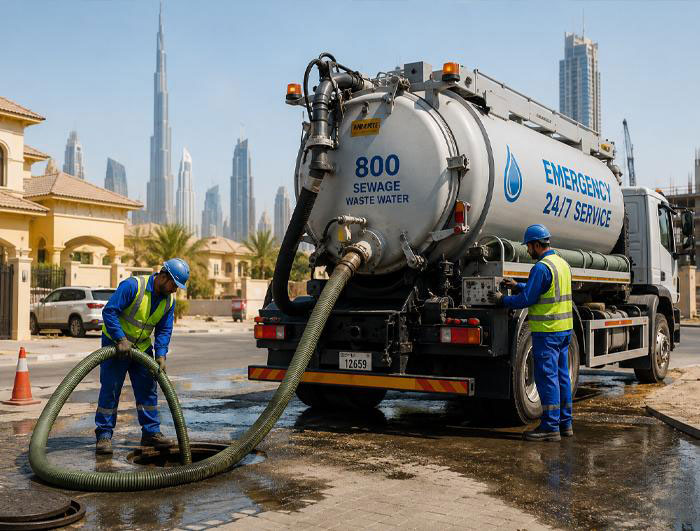
Restaurant & Catering Wastewater Collection Dubai:
A Complete Guide for Restaurants, Kitchens and Catering Businesses
Home | Blog
A Complete Guide for Restaurants, Kitchens and Catering Businesses
Home | BlogRestaurants, cafés, hotels, cloud kitchens and catering companies generate large quantities of wastewater every day. Unlike residential wastewater, commercial food-service wastewater can contain cooking grease, fats, oils, food particles, detergents and other residues.
If these materials are allowed to accumulate inside drainage systems, they can contribute to blocked pipes, unpleasant odours, overflowing grease traps and operational disruptions.
For this reason, wastewater management should be part of the daily operating plan of every food-service business.
Restaurant & Catering Waste water Collection Dubai involves more than simply removing wastewater from a kitchen. It requires understanding where wastewater is generated, controlling food and grease entering drainage systems, maintaining collection infrastructure and arranging appropriate removal or disposal.
Dubai Municipality maintains specific legislation and technical guidance covering waste management, sewage and wastewater-related activities. Its current Waste & Sewerage Agency legislation includes Law No. 18 of 2024 on Regulation of Waste Management in Dubai and Local Order No. 8 of 2002 concerning sewage, irrigation and water drainage.
Construction sites may require tanker services at different stages of a project.
During the early phase, permanent drainage infrastructure may not yet be available for all site facilities.
Temporary toilets and sewage tanks may therefore be used.
As the workforce increases, wastewater generation can increase considerably.
This is when a regular Sewage Tanker Service for Construction Sites Dubai schedule becomes particularly important.
Road, utility and infrastructure projects can cover large areas and may have temporary facilities distributed across multiple locations.
Centralising or coordinating wastewater collection becomes more important in these circumstances.
Labour accommodation and temporary welfare facilities can generate sewage continuously and may require scheduled tanker removal.
Construction Site Sewage Removal Dubai is not simply an emergency pumping activity.
For a well-managed construction project, sewage removal can be incorporated into the site's facilities-management plan.
Project managers should consider:
For example, a site with a large workforce and limited tank capacity may require frequent collection, while a smaller site may need a less frequent schedule.
The right approach is therefore based on actual site conditions rather than applying one collection frequency to every construction project.
Temporary construction facilities may include:
Each facility contributes to the site's wastewater requirements.
A planned Sewage Water Removal Dubai service can help keep these facilities functional throughout the construction period.
Regular removal also allows site management teams to identify unusual changes in wastewater generation. A sudden increase could indicate higher workforce numbers, a leak, damaged infrastructure or changes in site operations.
Not all water found on a construction site is sewage.
A site can also generate:
These streams should not automatically be mixed together.
Construction Site Wastewater Removal Dubai should therefore begin with identifying the source and characteristics of the water.
Dubai Municipality lists services relating to construction projects and wastewater, including an NOC for discharging groundwater into temporary lagoons and an NOC for withdrawing or discharging groundwater and wastewater into the sea under applicable requirements.
This demonstrates why contractors should identify the wastewater stream before selecting a disposal method.
A common mistake is treating every liquid on a construction site as the same waste.
Sewage generated from toilets is fundamentally different from groundwater, rainwater or certain construction-related wastewater streams.
Mixing different waste streams can complicate:
For this reason, Construction Site Wastewater Removal Dubai should be based on the origin and nature of the wastewater.
Project managers should clearly identify tanks and collection points so workers know which wastewater should enter each system.
Construction companies may search for Sewage Tanker Rental Dubai when they need wastewater removal equipment for a project.
However, contractors should determine whether they need a complete collection and disposal service or simply access to a tanker.
This distinction matters.
A complete service may include:
Before arranging Sewage Tanker Rental Dubai, project managers should clarify whether the tanker is supplied with an operator, whether disposal is included and what responsibilities remain with the contractor.
RTA's published rules for sewage and drainage vehicle rental include specific conditions, including requirements concerning authorised use and tanker operation.
Therefore, contractors should confirm the exact service arrangement rather than assuming every tanker rental package works in the same way.
There is no single tanker size suitable for every project.
The required capacity depends on the site's wastewater volume and collection frequency.
A contractor should consider:
More workers generally means greater sewage generation.
A larger tank may allow longer intervals between collections, subject to the applicable requirements and site conditions.
The tanker must be able to reach the relevant collection point safely.
A short-term project may require a different arrangement from a multi-year development.
Frequent smaller collections may be more practical than infrequent large-volume collections depending on site logistics.
The objective is to create a collection plan that prevents tanks from reaching an operationally problematic level.
After collection, sewage needs to reach an appropriate treatment or disposal destination.
Construction Site Sewage Disposal Dubai should therefore be considered together with collection and transportation.
Contractors should ask potential service providers:
Dubai Municipality states that sewage tankers can be registered for unloading at Dubai Municipality treatment plants.
RTA's activity card also states that sewage and sanitation water may be transported to locations for reuse, treatment or disposal by means permitted by the competent authorities.
One of the biggest advantages of scheduled collection is predictability.
Construction managers already coordinate:
Wastewater collection should fit into the same operational schedule.
A planned Construction Site Sewage Removal Dubai programme can reduce the likelihood of last-minute pumping requirements.
For larger projects, the contractor can create a weekly or monthly collection schedule and adjust it according to actual tank levels.
Even with good planning, emergencies can happen.
A sewage tank can fill faster than expected because of:
An emergency Sewage Tanker Service Dubai can provide a response when the normal collection schedule is insufficient.
However, emergency service should ideally complement rather than replace routine planning.
A contractor that repeatedly requires emergency pumping may need to review tank capacity, collection frequency or workforce estimates.
Sewage management is also connected to worker welfare.
Functional sanitation facilities are essential on an active construction site.
If toilets or wastewater facilities become unusable because of an overflowing tank, workers may face unnecessary inconvenience and hygiene concerns.
Regular Construction Site Sewage Removal Dubai helps maintain the usability of sanitation infrastructure.
The goal is not merely to remove waste. It is to maintain a functioning site environment in which workers can access necessary welfare facilities throughout the project.
Tanker collection should be coordinated carefully with construction-site traffic.
A site may have excavators, cranes, trucks, forklifts and other heavy equipment moving throughout the day.
When a sewage tanker arrives, the site team should consider:
RTA's commercial transport framework requires authorised sewage tanker operators to comply with technical and operational requirements, including vehicle inspection, licensing and other conditions.
The contractor should also follow the site's own health and safety procedures.
Wastewater removal should be documented as part of the project's environmental and facilities-management records.
Useful records can include:
Record keeping becomes particularly valuable on large projects where multiple tankers and collection points may be involved.
RTA's sewage tanker activity requirements include maintaining records containing information related to the practice of the authorised activity.
Tanker removal is necessary in many temporary-site situations, but good site management can make the system more efficient.
Do not wait until a tank is completely full before arranging the collection.
Use workforce numbers and historical collection data to estimate requirements.
Tanker operators need safe and practical access to the collection point.
Keep sewage separate from other construction-related wastewater where required.
Workers should know where sanitation wastewater goes and what should not be discharged into the system.
Damaged toilets, pipes or tanks can increase wastewater-management problems.
For construction companies managing multiple temporary facilities, Sewage Water Collection can be incorporated into a wider wastewater-management plan covering scheduled pumping, tanker transportation, treatment and disposal.
The important point is to design the system around the actual project rather than waiting for wastewater problems to occur.
Sewage management is an important part of construction-site planning in Dubai.
Temporary sanitation facilities, worker accommodation and site offices can generate significant wastewater during a project's construction phase. Without a reliable removal plan, a full sewage tank can quickly become an operational problem.
A properly planned Sewage Tanker Service for Construction Sites Dubai gives contractors a structured way to manage accumulated sewage while keeping sanitation facilities operational.
The right Sewage Tanker Service Dubai should be selected according to the project's workforce, tank capacity, site access, collection frequency and disposal requirements.
Similarly, Construction Site Sewage Removal Dubai and Sewage Water Removal Dubai should be incorporated into routine site planning rather than being treated only as emergency services.
For projects generating other wastewater streams, Construction Site Wastewater Removal Dubai should begin with identifying the source and characteristics of the water. This helps determine the appropriate collection and disposal route.
When arranging Sewage Tanker Rental Dubai, contractors should also establish whether the agreement covers only the vehicle or includes pumping, transportation and disposal.
Finally, Construction Site Sewage Disposal Dubai should be connected to the complete chain of collection, transportation and appropriate treatment or disposal.
Dubai's regulatory framework specifically covers sewage tanker transport, and Dubai Municipality provides a registration route for sewage tankers unloading at its treatment plants.
For construction companies, the most effective strategy is straightforward: estimate wastewater generation, provide adequate temporary storage, schedule tanker collection before capacity becomes a problem, maintain safe tanker access and keep appropriate service records.
With the right planning, sewage management becomes a predictable part of construction-site operations rather than an unexpected source of delays.
A Sewage Tanker Service for Construction Sites Dubai is a wastewater-removal service that uses pumping or vacuum tankers to collect sewage from temporary tanks, sanitation facilities and other suitable collection points and transport it to an appropriate treatment or disposal destination.
Construction sites may operate before permanent sewer infrastructure is available. Temporary toilets, welfare facilities and worker accommodation can generate sewage that needs regular removal.
A tanker arrives at the site, connects suitable pumping equipment to the sewage storage system, removes the accumulated wastewater and transports it to an appropriate destination. The exact procedure depends on the site and applicable requirements.
Construction Site Sewage Removal Dubai refers to the pumping, collection and transportation of sewage generated by construction-site sanitation facilities and temporary wastewater systems.
There is no universal frequency. It depends on workforce size, tank capacity, daily wastewater generation and site operating conditions. A high-workforce project may require frequent removal, while a smaller site may require less frequent service.
Not necessarily. Sewage Tanker Rental Dubai may refer to access to a tanker vehicle, while a complete sewage-removal service can include pumping, transportation and treatment/disposal. Contractors should confirm exactly what is included.
Construction Site Wastewater Removal Dubai is a broader term covering the removal of wastewater generated at construction sites. It may include sewage and other wastewater streams, but the correct disposal route depends on the source and characteristics of the water.
Construction Site Sewage Disposal Dubai involves transporting collected sewage to an appropriate treatment or disposal destination. Contractors should verify that the service provider and tanker arrangements meet the applicable requirements.
Not automatically. Different wastewater streams may have different characteristics and disposal requirements. Sewage, groundwater, rainwater and contaminated construction water should be assessed separately before combining or transporting them.
Contractors should check the provider's relevant registration or permissions, tanker suitability, collection capacity, operator arrangements, disposal route, documentation, emergency availability and ability to access the construction site safely.

Committed to delivering efficient wastewater collection and treatment, we ensure clean and sustainable solutions for a healthier future.